Shelf Label Holders – ESL Label Compatibility Finder

ESL Label Compatibility Finder

Shelf Label Holders – ESL Label Compatibility Finder

ESL Label Compatibility Finder

Start with the electronic label your store already ordered, then work back to the physical hardware that carries it. This finder maps a label model to the rail, adapter and holder you can actually order, covering shelf label holders as well as clip-on and rail-integrated shelf edge label holders, and it reduces every decision to three fit points that a caliper can settle before you order.

Fit basis Profile width, insertion depth, clip tension
Product on record ESL Rail Label Holder for supermarket shelf labeling
How to order Send your label model and shelf edge thickness
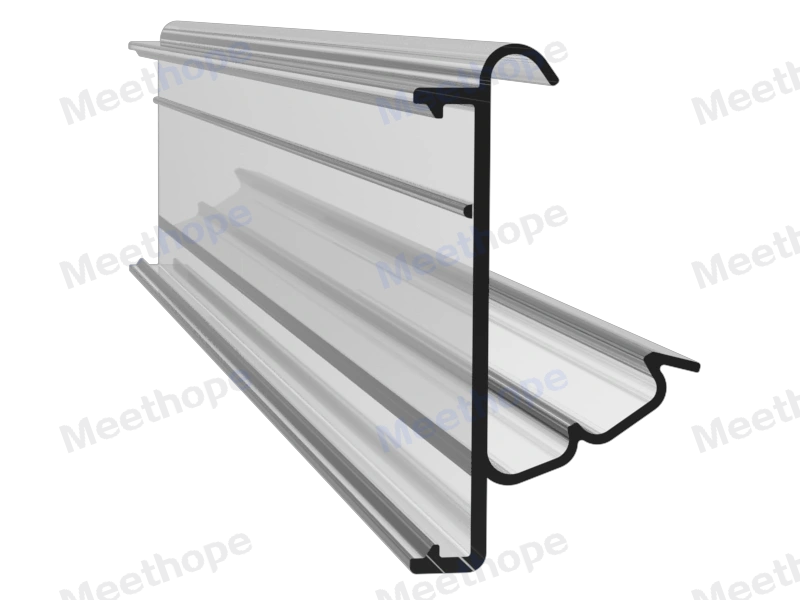
Meethope Code MEE-NT010 ESL rail label holder in transparent PVC

What This Finder Covers

Give us a label model and this page shows the route to a holding solution: which rail profile family to shortlist, whether an adapter rail is needed, which holder form factor suits the shelf, and whether a flip-up hinge is worth specifying. Everything below rests on three definitions, so they come first.

Measure 01

Profile width

The opening that receives the label body. Measure the label's own width across its seat, not the width of the rail you are replacing.

Measure 02

Insertion depth

How far the label back plate travels from the front lip to the rear stop. A label that sits too deep loses its scan angle; too shallow and it rattles.

Measure 03

Clip tension

The grip against the shelf edge. It depends on shelf edge thickness and material, and it is the fit point most often skipped on a rollout.

Where a pairing has not been confirmed for a specific label model, the lookup shows a "confirm with us" state instead of a recommendation. A wrong guess costs a return and a stalled aisle; a question costs a minute.

ESL Fit Lookup Matrix

One row per label family. Read across to see which fit points decide the holder, what to send us, and where the pairing still needs confirming against the label in your hand.

Label family Seat to confirm Rail or adapter Flip-up option What to send
SOLUM Newton Label depth and any rear ridge on the housing Rail-integrated holder or adapter rail, depending on your existing rail Hinge option to confirm against tilt clearance The exact label code plus shelf edge thickness
ATEC AP Housing thickness at the seat face Holder family shortlisted from the seat measurement Hinge option to confirm if the aisle is restocked daily The exact label code and a photo of the current rail end
Vusion / SES-imagotag Housing depth and rear contour, several variants share the platform Adapter rail is usually the fastest route across a mixed fleet Hinge option to confirm per aisle type The variant code, because one family can carry more than one housing
G1 rail labels Label thickness measured at the seat, not the screen Rail profile matched to insertion depth Hinge option to confirm Label code plus the shelf edge thickness of the fitted fixtures
Other or private-label ESL Width, depth and rear contour of the housing Three measurements are enough for us to shortlist a holder Hinge option to confirm Three measurements and the quantity per store

Rows are added when a label family has been confirmed against a real label and a real shelf edge, not from a catalogue picture. New families are added on request, and every new store set is checked again before an order is released.

Label brand names appear on this page for identification only. No affiliation, sponsorship or endorsement by those brands is implied.

Rail Profile Anatomy: Where the Three Fit Points Sit

A label does not "fit a rail" in the abstract. It seats in a specific opening, is held by a specific grip, and needs clearance behind the shelf lip. The schematic below shows the measurement points in the order that decides a match.

Schematic cross-section, not to scale. Callout numbers match the list beside it. No dimensions are printed on the drawing because the product listing does not publish them; each figure is confirmed per shelf.

  1. 1

    Profile width

    Measure the label across its widest seated face. This tells you the opening the holder must offer, and it is the first filter that removes holders from your list.

  2. 2

    Insertion depth

    Measure from the front lip to where the label's back plate stops. Too much depth and the screen tilts away from the shopper's eye line; too little and the label sits proud of the rail.

  3. 3

    Clip tension

    Governed by shelf edge thickness and material. Thin metal lips and thick plastic lips of the same nominal shelf need different grip, so measure the edge rather than assuming a standard.

  4. 4

    Rail body clearance

    Look behind the lip before ordering. Shelf stiffeners, old price strips and wire dividers can all block a rail body that looks correct from the front.

  5. 5

    Seat surface

    Flat seats and ridged seats hold a label differently. Match the label rear contour to the seat, because this is where a holder that "almost fits" starts letting labels drop.

Holder Type Selector: Match the Mount to the Shelf

If you do not yet know your label model, start here instead. The mounting style is decided by the shelf edge condition and by how often your team touches the label during a shift.

Mount type A

Clip-on holder

Clips directly onto the shelf lip without drilling or adhesive, so a single aisle can be fitted in one pass during a night shift.

Use whenShelf edges are clean and uniform, and you want a tool-free install that can be moved between fixtures.
Mount type B

Adhesive holder

Bonds to a flat shelf face or display panel where there is no rail to grip, which is common on glass, acrylic and end-cap surfaces.

Use whenThere is no rail, the surface is flat and smooth, and the label position changes rarely.
Mount type C

Rail-integrated holder

A rail and holder specified together as one part of the fixture, giving a consistent seat across every aisle of a new store or a full refit.

Use whenYou are specifying new shelving or replacing the price rail itself, and want one fit standard across the store.
See the ESL Rail Label Holder →
Mount type D

Flip-up hinge holder

The holder tilts the label forward so staff can reach the shelf behind it without prising the label out of the rail.

Use whenRestocking is heavy or frequent, and labels are currently being dislodged, dropped or re-seated during replenishment.

Product Record: ESL Rail Label Holder

This is the one product on record behind this finder. The record below states only what the listing itself confirms, and flags the specification gaps you should close before an order is raised.

MEE-NT010 ESL rail label holder shown from the rail end
  • Listing titleRetail Display Solutions with ESL Fittings
  • Product descriptorESL Rail Label Holder
  • Category roleElectronic shelf label accessory and adapter rail for ESL
  • Stated applicationSupermarket shelf labeling within retail display fittings
  • Published dimensionsNot stated on the listing — confirmed per shelf edge before a quote is issued
  • Material and load dataNot stated on the listing — confirmed against your in-store conditions
  • Ordering routeQuotation through the contact form; the listing carries no add-to-cart step

Scenario-to-Specification Decisions

Six situations cover most enquiries. Find the row that matches your store, then check the fit point that decides it before you specify a quantity.

Your scenario Fit point that decides it Confirm before ordering Direction to take
New store or full refit Insertion depth across standard shelf types Shelf edge thickness per fixture type and the label model for each aisle Specify a rail-integrated holder and set one fit standard for the whole store
Retrofit onto existing price rails Profile width and seat surface Existing rail profile, ridge or flat seat, and label depth Shortlist a clip-on or adapter rail rather than replacing the rail
Heavy-restock aisles such as beverages and promotions Clip tension and label retention How often labels are currently dislodged, and the clearance needed to tilt Ask about a flip-up hinge option for those aisles only
Chilled and freezer zones Clip tension and material behaviour in cold air Shelf lip thickness, condensation exposure and cleaning routine Confirm the holder material and grip before specifying the whole cold chain
Front-of-store with high daylight exposure Material durability at the seat Hours of direct light and whether an anti-UV option is required Raise the anti-UV and recycled PVC question at enquiry stage
Mixed label fleet across stores Insertion depth per label family A depth list per model, store by store Use a common holder family with adapter rails instead of one holder per brand

Measure Before You Order: Five Steps

Work through these five steps on one shelf per fixture type. The same numbers then cover every aisle that uses that fixture, and they remove almost all of the guesswork from the matrix above.

  1. Label depth at the seat

    Measure the housing from the front face to the back plate, not the diagonal across the screen.

  2. Shelf edge thickness

    Measure the lip itself with a caliper where you can. This single number decides clip tension.

  3. Rail profile and seat

    Record whether the current rail has a flat or ridged seat, and photograph the end of the rail.

  4. Clearance behind the lip

    Check for stiffeners, old price strips and wire dividers that would block a rail body.

  5. Aisle behaviour

    Note how often the aisle is restocked and whether labels are being dislodged during replenishment.

Send Your Label Model and Shelf Edge Thickness

One enquiry with the right four inputs is enough for us to come back with a holder recommendation, a quantity breakdown and a quote. If a pairing cannot be confirmed for your label, we will tell you that plainly instead of guessing.

  • Label brand and model code, plus any variant suffix
  • Shelf edge thickness and whether the seat is flat or ridged
  • Quantity per store and the number of stores in the rollout
  • Environment notes: chilled or freezer aisles, daylight exposure, restocking frequency

Related Reading

Three notes to help clarify product requirements before contacting the supplier.

Anti-UV and Recycled PVC Options for Electronic Shelf Label Rails

Anti-UV PVC, 100% new material, and 40% pre-consumer recycled PVC are three different purchasing choices for the same shelf rail, and each one changes what you ask a supplier before ordering.

Read article

Which ESL Rail Fits SOLUM Newton and ATEC AP Labels?

The rail decision begins once SOLUM Newton or ATEC AP labels are selected, with fit depending on label model, screen size, and the 30mm shelf edge profile.

Read article

How Do Flip-Up Hinges Protect Electronic Shelf Labels During Restocking?

A flip-up hinge protects an electronic shelf label by letting the rail edge move out of the way when hands, boxes, or crates arrive during restocking.

Read article

Frequently Asked Questions

What information is shown for this product?

Review the product details, images, and specifications presented on the official product page.

Where can I check the intended application?

Use the application and use-case information published on the official product page.

Which specifications should I confirm before ordering?

Confirm the specifications and options listed for the exact product variant before placing an order.

Where can I check available options?

Check the official product page or ask the supplier about options shown for the selected product.

How can I request product information?

Use the official contact or inquiry path provided on the site.

What should I include in an inquiry?

Include the product page, intended use, required quantity, and any specifications you need the supplier to review.